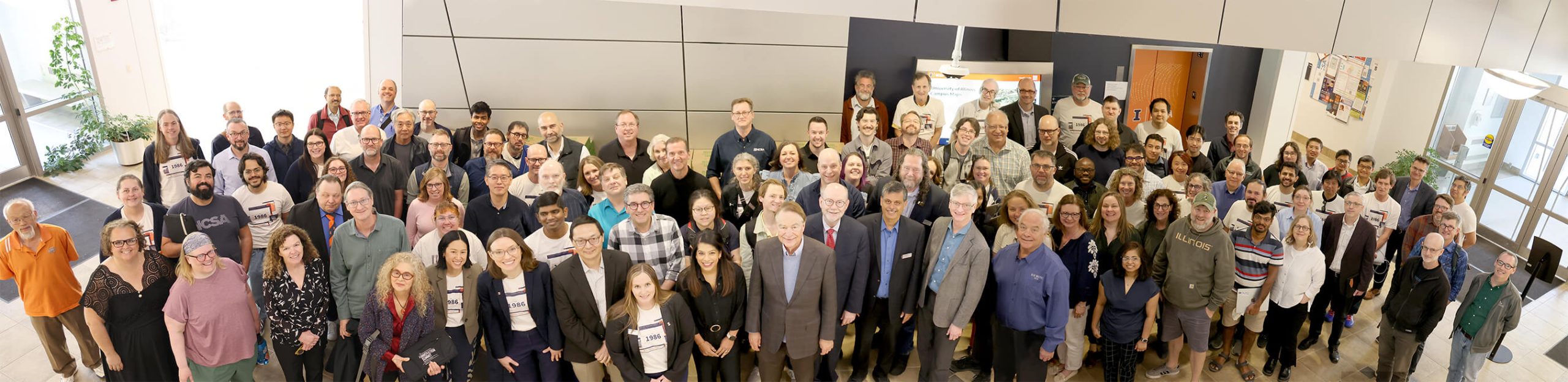
Since 1986, we’ve been at the epicenter of supercomputing research, pioneering innovations in technology and using them to solve the pressing questions of the day.
From the first popular graphical web browser to ground-breaking research in medicine and astrophysics, we don’t just push the envelope; at NCSA, we give it our own unique stamp, taking Illinois innovation into the forefront of research around the world.
1986–1990s
Igniting a Supercomputing Revolution
January 1986
Responding to a “famine” of supercomputing power for United States researchers, Illinois astrophysicist Larry Smarr and seven Illinois colleagues submitted an unsolicited proposal to the U.S. National Science Foundation (NSF) asking for funding to launch supercomputing centers. NSF responded in 1985 by establishing the National Center for Supercomputing Applications with Smarr as its first director. NCSA “opened for business” early in 1986.
Connecting Computers and the World
1986
The NCSA Software Development Group created the widely used software NCSA Telnet, which allowed users to access NCSA’s supercomputer as another window on their local machines. Telnet was one of several software products, including HTTPd, HDF, Habanero, Portfolio and others, that established NCSA as a long-term provider of software that enabled scientific research.
Collaborations that Power Discovery
February 1987
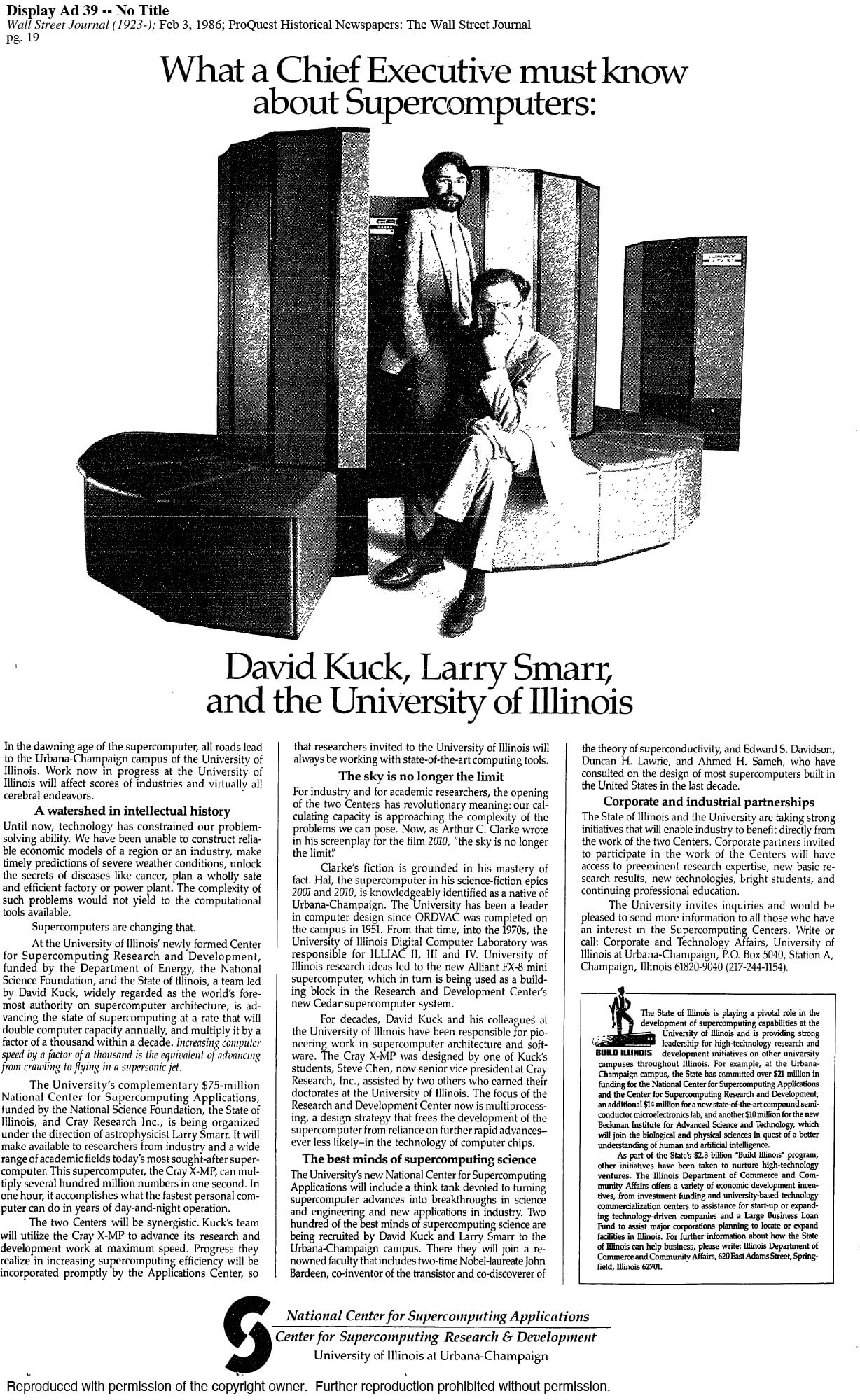
“In the dawning age of the supercomputer, all roads lead to the Urbana-Champaign campus of the University of Illinois.” So began the iconic Wall Street Journal ad placed by NCSA, inviting corporate and industrial partnerships. NCSA established what became the Industry Partner Program to bridge the gap between supercomputing and the corporate world, and corporate giants embraced the opportunity to use high-performance computing to accelerate discovery.
Seeing the Unseen
July 1989
A thunderstorm visualization from NCSA’s Matthew Arrott and Bob Wilhelmson made its debut at the annual SIGGRAPH Conference, showing the possibilities of data-driven visualization with the power of supercomputing.
Unwrapping the Past
January 1991
An Egyptian mummy was donated to the University of Illinois World Heritage Museum (now the Spurlock Museum), prompting a team of researchers to use NCSA’s Cray-2 and CM-2 supercomputers to construct 3D volumetric renderings from 2D CT scans. NCSA developed custom imaging software to power the reconstruction that revealed preserved internal organs. Later carbon dating showed the mummy was a child from the Roman occupation of Egypt, roughly 2,000 years ago.
Data-driven Healing
January 1992
Eli Lilly and Company and a team of researchers worked with NCSA to visualize more than two gigabytes of data to aid the fight against asthma. The year-long collaboration yielded a 45-minute animation that analyzed and compared the shapes of three known leukotriene molecules.
Bringing the Web to the World
January 1993
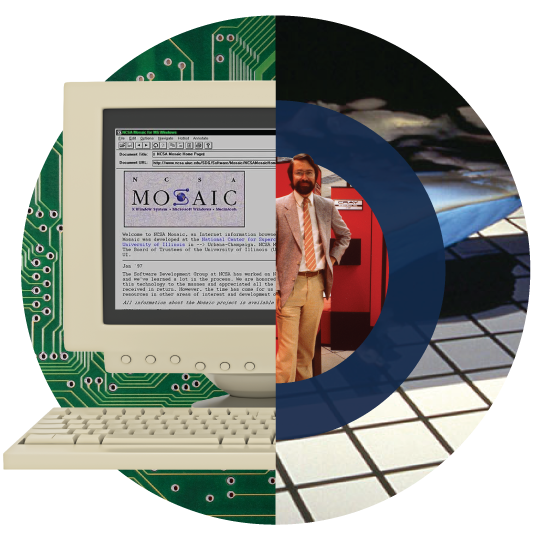
NCSA’s Mosaic became the world’s first popular graphical internet browser. By the time it landed on the cover of the New York Times business section in December 1993, more than 5,000 copies of the browser were being downloaded a month, and the Center received hundreds of thousands of email inquiries a week. Decades later, Mosaic continues to elicit a strong sense of nostalgia for many early internet users.
Software that Served the Web
1993
Developed by NCSA and released in 1993, HTTPd was a web server that powered most of the early internet. The Apache Foundation later formed, assumed its ongoing development, and used HTTPd as the foundation for the Apache HTTP Server, a free and open-source web server that remained popular worldwide for decades.
The Evolving HPC Funding Model
January 1996
NSF’s funding for HPC research evolved into the Partnerships for Advanced Computational Infrastructure (PACI) model. The NCSA Alliance and San Diego Supercomputing Center’s National Partnership for Advanced Computational Infrastructure (NPACI) received funding for hardware in parallel with the NSF TeraGrid high-speed network and computing grid.
2000s
Passing of the Torch
March 2000
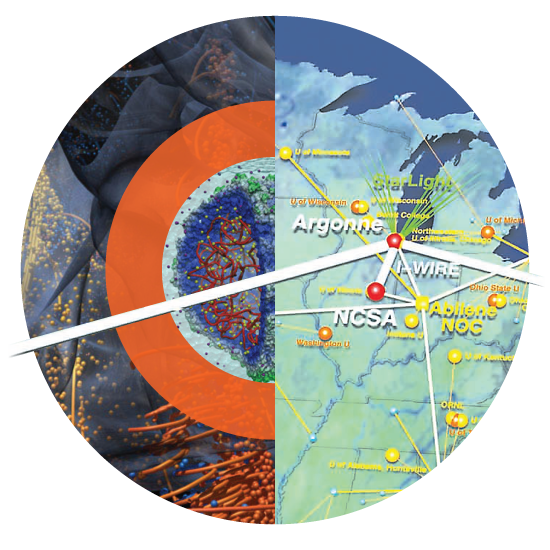
Larry Smarr, NCSA’s first director, stepped down after 14 years. Each director who took the baton after Smarr has advanced his initial vision while making their own contributions to the Center’s success. NCSA continues to thrive under the guidance and stewardship of luminaries in the HPC space.
The Power of Distributed Research Resources
August 2001
NSF awarded $53 million to four U.S. research institutions, including NCSA, to build and deploy a distributed terascale facility, or TeraGrid. At the time, TeraGrid was the largest, most comprehensive infrastructure ever deployed for scientific research.
From Consoles to Computation
May 2003
When Sony released the Linux Kit for the PlayStation 2 (PS2) game console, interest in the machines spread beyond the gaming community. Researchers at NCSA theorized that because of the unique processor of the PS2, a cluster of consoles could be used for scientific computation. The New York Times published this article.
Bringing Hard Science to TV Screens
November 2004
The TV series NOVA aired “Hunt for the Supertwister,” which focused on the search for understanding nature’s most violent tornadoes. The show featured data-driven tornado visualizations produced by NCSA’s Experimental Technologies Division.
A Digital Blueprint of Life
March 2006
There had never been a computer simulation of an entire life form in atomic detail until NCSA helped simulate the satellite tobacco mosaic virus. The research, led by Beckman Institute’s Klaus Schulten, relied on the shared-memory SGI Altix supercomputer at NCSA and appeared in the March edition of the journal Structure.
Research in Parallel
October 2008
NCSA launched Lincoln, the first GPU supercomputer at scale using NVIDIA GPUs. Networked with the Abe supercomputer, the two resources allowed “single applications to use 152 teraflops” and introduced GPUs to scientific computing.
2010s
From Supercomputers to the Silver Screen
March 2010
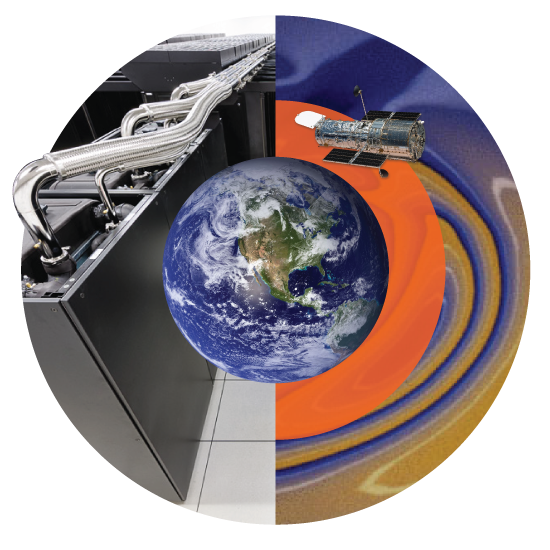
NCSA’s Advanced Visualization Laboratory developed two scenes for the “Hubble 3D” IMAX film. Comprising nearly 10 minutes of the 43-minute film, the sequences used real Hubble, astronomical and computational data in visualizations to make audiences feel they were on a space journey.
The Next Frontier in HPC Collaboration
January 2011
The Extreme Science and Engineering Discovery Environment (XSEDE) was a powerful collection of integrated digital resources and services, supercomputers, visualization and storage systems that made them more accessible to researchers worldwide. The five-year, $121 million project was supported by NSF and led by NCSA.
A New Wave of Discovery
January 2013
When Blue Waters opened for science, it was one of the world’s most powerful supercomputers and one of the fastest on a university campus. Researchers across the country used its computing and data power to tackle a wide range of challenging problems, from predicting complex biological systems to simulating the evolution of the cosmos.
Capturing the Fabric of Spacetime
February 2016
NCSA played a role in developing the tools needed for simulating relativistic systems that helped scientists observe gravitational waves arriving on Earth from a cataclysmic event. This detection confirmed a major prediction of Albert Einstein’s 1915 general theory of relativity.
The AI Era Begins
2017
The Hardware-Accelerated Learning (HAL) cluster was designed to speed up deep learning research. The focus on data-intensive projects within the HAL cluster allowed for research in fields such as natural language processing, computer vision, healthcare and more.
Earth’s Digital Cartography
August 2019
NCSA spearheaded a collaboration between the Blue Waters Project, the National Geospatial-Intelligence Agency and others to produce digital elevation models of the entire Earth, among other geospatial research projects. The collaboration made Blue Waters the most powerful dedicated, non-classified geospatial system in the world.
2020s
Combatting COVID-19
March 2020
NCSA and the University of Illinois Urbana-Champaign joined the C3.ai Digital Transformation Institute, a multi-disciplinary effort focused on AI and advanced computing related to the abatement of COVID-19. The institute was announced in The New York Times.
The Most Precise Map of the Night Sky
June 2021
Results from the Dark Energy Survey (DES) used the largest-ever sample of galaxies to produce the most precise measurements of the universe’s composition and growth to date. Over six years, DES surveyed 5,000 square degrees – almost one-eighth of the entire sky – in 758 nights of observation, cataloging hundreds of millions of objects.
A Masterclass in System Longevity
December 2021
The Blue Waters supercomputer ended its historic run powering scientific research after nine years, four more than its intended five-year lifespan. Awarded to NCSA by the NSF in 2007, Blue Waters continued operation through strategic cost-reduction investments, innovative system and service methods, experienced project management and substantial support from NSF and the National Geospatial-Intelligence Agency.
Democratizing Access to Resources
April 2022
The National Science Foundation awarded NCSA two grants totaling more than $20 million as part of its Advanced Cyberinfrastructure Coordination Ecosystem: Services and Support (ACCESS) program. ACCESS succeeded NSF’s XSEDE integrated digital resources and services, which NCSA led for 11 years.
A GPU Revolution
October 2022
NCSA deployed Delta, a GPU-heavy compute cluster funded by the NSF. Combined with its high-performance file system and features for broader accessibility to communities that have not historically used HPC systems, Delta has accelerated the adoption and use of these techniques across all areas of research.
A National Blueprint for AI
January 2024
NCSA was named one of the primary NAIRR pilot program partners to develop a national AI research infrastructure that connected researchers and educators with essential AI computing resources.
A Lens into the Early Universe
June 2025
The NSF–DOE Vera C. Rubin Observatory, funded by the NSF and the U.S. Department of Energy’s Office of Science (DOE), published its first images. NCSA and the Center for AstroPhysical Surveys (CAPS) contributed by gathering data for the images, transferring it between sites and orchestrating image processing campaigns.