The National Center for Supercomputing Applications (NCSA) may be best known for the “Black Proposal,” the Blue Waters supercomputer or creating a computing cluster out of PlayStation 2 gaming consoles. But one of the foundational pillars in the legacy of innovation at NCSA has always been its commitment to teaching and training researchers on the newest methods and technologies in research computing.
NCSA is following that tradition as artificial intelligence continues its ascent as a powerful research tool. AI is rapidly transforming research, and knowing where to begin, choosing the right tools and harnessing the power of high-performance computing can be challenging. That’s why NCSA is hosting an in-person “Regional Workshop on AI” on October 5-6 on the University of Illinois Urbana-Champaign campus, designed to help researchers from around the Midwest move from AI curiosity to practical capability.
This two-day workshop brings together academic researchers who are new to machine learning as well as those ready to build upon their intermediate skills. Through hands-on training, guided exercises, real-world examples and interactive sessions, participants will learn how AI and HPC can work together to accelerate discovery across disciplines.
“We are excited to host a regional workshop on the use of computing resources, the basics of machine learning and its application to various topics,” said Technical Assistant Director Greg Bauer. “Enabling all researchers at all levels is a goal of the Delta and DeltaAI projects at NCSA.”
Build Skills to Put to Work
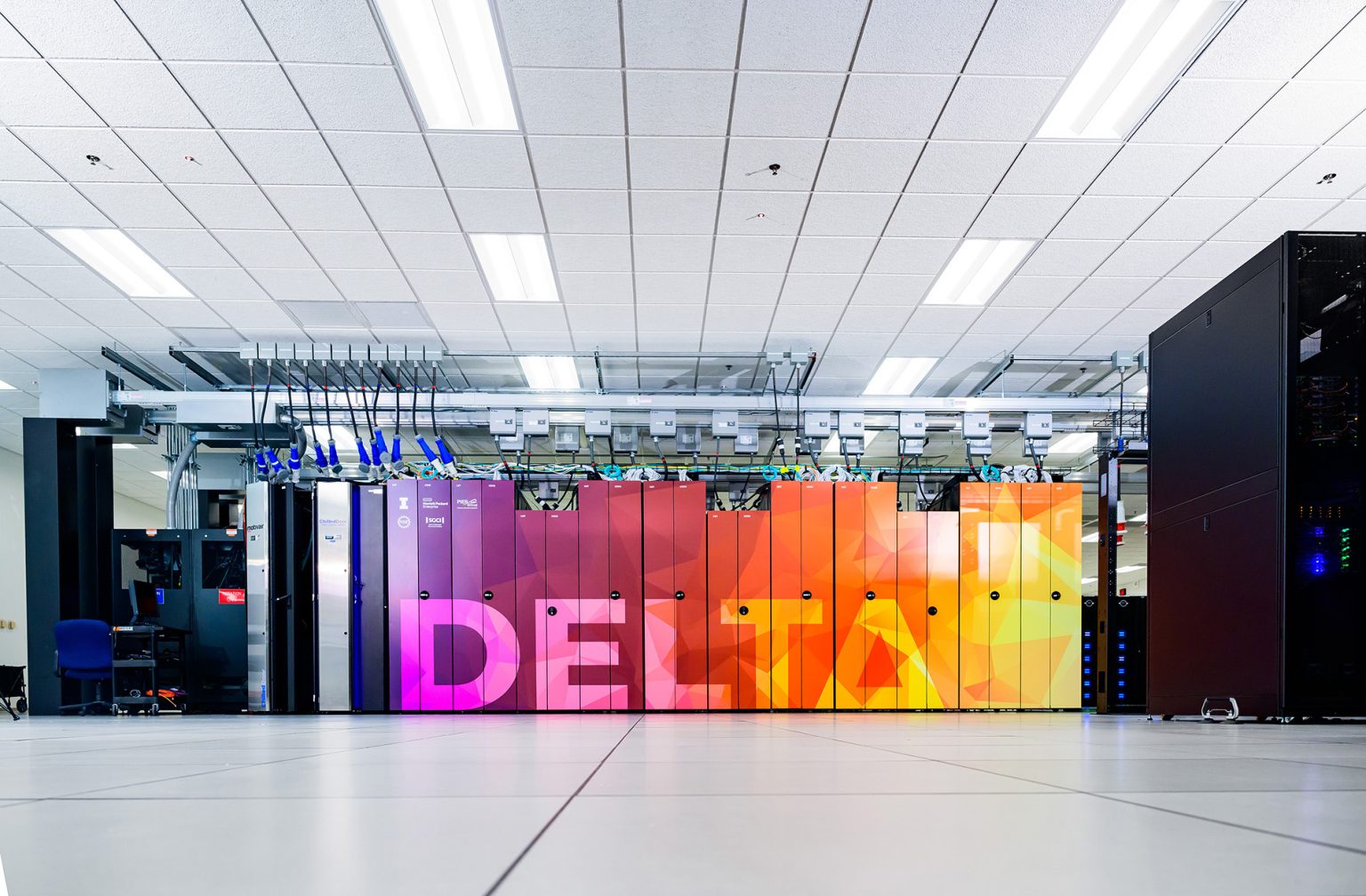
Organized by the teams supporting NCSA supercomputers Delta and DeltaAI, the workshop will have two complementary learning paths with a shared keynote speaker on the first day and panel and networking sessions throughout.
The “Getting Started with AI on HPC” track provides practical foundations, including navigating an HPC environment, working with Jupyter notebooks and exploring machine learning workflows, hardware accelerators and AI deployment tools.
For researchers ready to explore more specialized applications, the “Advanced Methods/Domain Specific” track dives into emerging and discipline-focused topics, including AI agents for research, AI in genomics, scientific machine learning and geospatial machine learning.
The result is more than an introduction to AI. Participants will gain experience with tools and workflows that can help reduce barriers to advanced computing and open new possibilities for their own research. Check out the event webpage for the full workshop schedule and register soon! Space is limited to 80 participants.
“We designed the workshop with a dual-track approach to meet researchers exactly where they are in their AI journey,” said Soham Pal, a research computing and data facilitator at NCSA. “By offering both foundational training and advanced, domain-specific sessions, we can simultaneously bridge the gap for beginners learning the basics of HPC and empower intermediate users to tackle specialized research challenges.
“Ultimately, this problem-centered structure ensures that every participant, regardless of their background, leaves with the hands-on experience and technical foundation needed to independently apply AI to their own work.”
Connecting AI to Research
AI is most powerful when it’s applied to meaningful scientific questions. Participants will have opportunities to see the technology in action, engage with experts and peers, and explore approaches that can translate directly to their work.
Electrical and Computing Engineering graduate student and NCSA researcher Priyam Mazumdar will lead a focused introduction to machine learning for the new-to-AI workshop attendees.
“There are plenty of tools for training existing models, but researchers will leave knowing how to stand up a GPT from scratch in PyTorch, including attention, the training loop, and all,” Mazumdar said. “That foundational knowledge is what you need if you want to go beyond the models we already have and actually build new ones!”
For a more specialized group, NCSA research scientists Weihao Ge and David Bianchi are hosting the “AI in Genomics” session.
“Researchers will learn how concepts such as transformers and language models can facilitate sequence and image analysis, and they’ll get a hands-on experience of the packages implementing these AI tools,” Ge said.
“They’ll also get an overview of the fast-moving world of AI+Biology, examples of recent applications and success stories at NCSA, and the opportunity to learn-by-doing: applying novel tools, models and techniques during interactive working sessions that leverage NCSA’s AI/HPC hardware, frameworks and expertise,” added Bianchi.
NCSA research scientist Qibang Liu is also presenting a more advanced offering to attendees, addressing the combination of traditional physics-based simulations with modern machine learning techniques.
“Researchers will come away with new skills, such as recognizing where machine learning can accelerate their own simulations, using physics-informed neural networks to solve differential equations and building a neural operator that predicts in a fraction of a second what a solver takes hours to compute,” Liu said. “They’ll do this hands-on, training and running a model themselves on Delta and DeltaAI.”
But newcomers to AI will not be left behind thanks to the parallel skill-level instruction. NCSA research software engineer Mathew Minu will provide an introduction to the DiamondHPC.AI framework, demonstrating its integrated toolsets built to simplify high-performance AI deployments.
“You do not need to be an HPC expert to train a model on a supercomputer,” Minu said. “Attendees will leave having built a container for their own training code and launched it on a GPU cluster without writing a single scheduler script.”
Designed for Broad Participation
The NCSA Regional Workshop on AI has a lot to offer researchers of all domains and computing skill levels.
The workshop is intentionally accessible and affordable for the research community. Registration is $25 for students, $50 for academic participants and $100 for industry participants. Limited financial assistance and travel support are available for eligible participants, including support specifically intended to help students attend.
Space and financial assistance are limited, so early registration is encouraged. Email the workshop organizers for additional information.
ABOUT DELTA AND DELTAAI
NCSA’s Delta and DeltaAI are part of the national cyberinfrastructure ecosystem through the U.S. National Science Foundation ACCESS program. Delta (OAC 2005572) is a powerful computing and data-analysis resource combining next-generation processor architectures and NVIDIA graphics processors with forward-looking user interfaces and file systems. The Delta project partners with the Science Gateways Community Institute to empower broad communities of researchers to easily access Delta and with the University of Illinois Division of Disability Resources & Educational Services and the School of Information Sciences to explore and reduce barriers to access. DeltaAI (OAC 2320345) maximizes the output of artificial intelligence and machine learning (AI/ML) research. Tripling NCSA’s AI-focused computing capacity and greatly expanding the capacity available within ACCESS, DeltaAI enables researchers to address the world’s most challenging problems by accelerating complex AI/ML and high-performance computing applications running terabytes of data. Additional funding for DeltaAI comes from the State of Illinois.