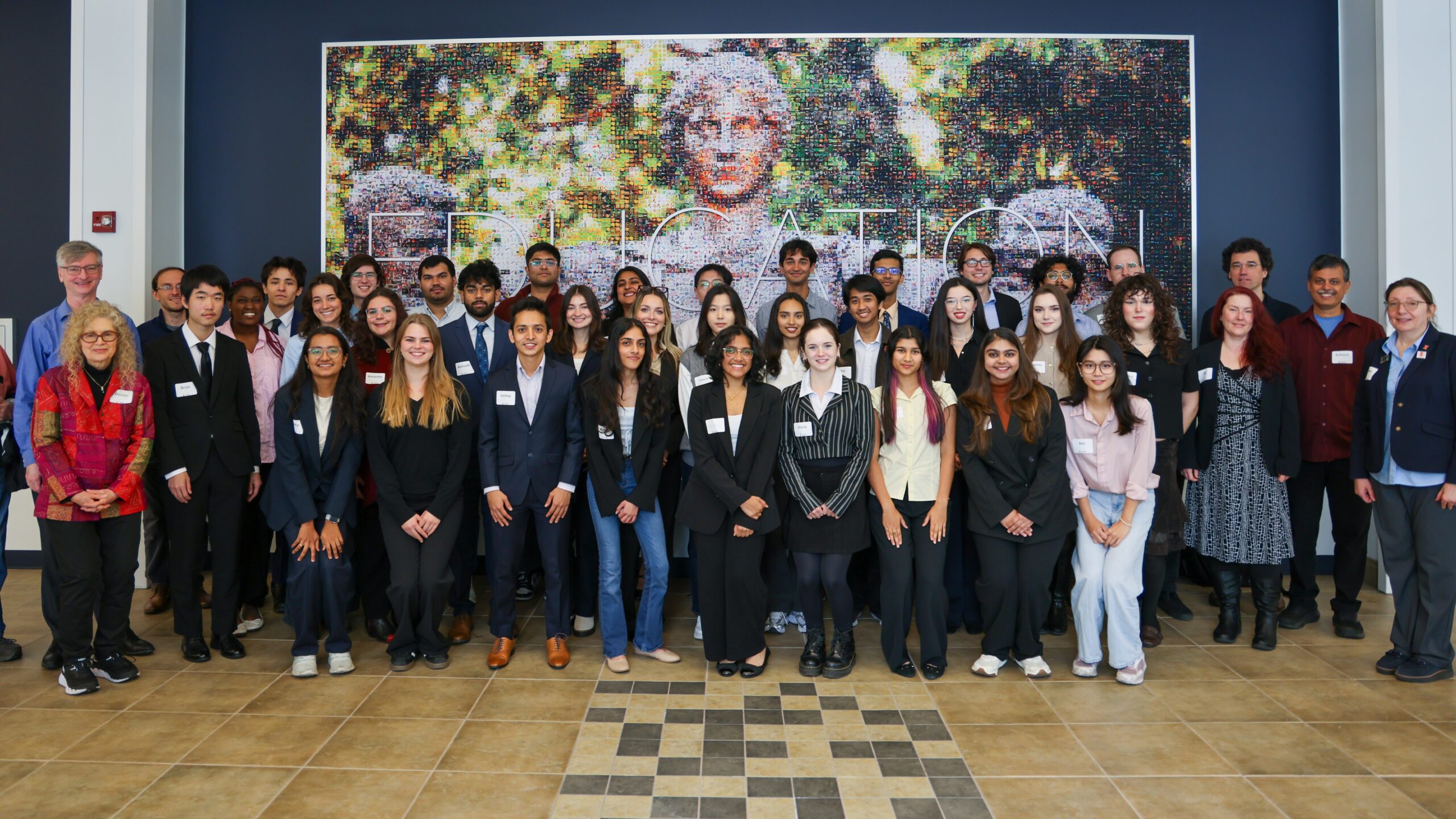
The National Center for Supercomputing Applications awarded Fiddler Innovation Fellowships to 38 University of Illinois Urbana-Champaign and NCSA graduate students in a ceremony on October 31 honoring their outstanding achievements and interdisciplinary contributions to NCSA programs, including Students Pushing Innovation (SPIN), NCSA’s Research Experiences for Undergraduates (REU) program titled “The Future of Discovery: Training Students to Build and Apply Open Source Machine Learning Models and Tools” (REU FoDoMMaT), Design for America (DFA) and those who worked with NCSA-affiliated faculty during the 2024-25 academic year and summer of 2025.
The awards are part of a $2 million endowment from Jerry Fiddler and Melissa Alden to the University of Illinois in support of student and faculty interdisciplinary research initiatives through the Illinois Emerging Digital Research and Education in Arts Media (eDream) Institute at NCSA.
The 38 awardees represent students whose outstanding interdisciplinary contributions to their projects showcased a wide range of research interests and domains, including environmental sustainability, music, personalized nutrition, agriculture and astronomy.
“NCSA is very grateful to have the generous support of Jerry Fiddler and Melissa Alden in providing this opportunity for our brightest student innovators. These students never cease to amaze me with their creativity and resourcefulness while utilizing NCSA’s research computing tools in imaginative and thoughtful ways.”
Bill Gropp, NCSA Director
SPIN participant Emma Maxwell relied heavily on her experience in the internship program for her project titled “Quantifying the Impact of Scientific Documentaries Using Natural Language Processing,” which led to her receiving a Fiddler Innovation Fellowship Award.
“Working on my SPIN project has allowed me to creatively approach my research,” Maxwell said. “The SPIN program’s poster presentation and lightning talk sessions have encouraged me to think about articulating my findings for a variety of audiences and to adapt my data presentation to different mediums. Additionally, my project has pushed me to think creatively in order to solve problems of modeling and quantifying highly qualitative text information, such as viewer enjoyment and learning.”
Through NCSA’s Center for Artificial Intelligence Innovation (CAII), three awardees collaborated on the mobile application Visual Nutrition, which utilizes AI photo recognition to track an individual’s meal data. The different academic backgrounds of Fiona Campbell in the School of Information Sciences, Kai Karadi in the Siebel School of Computing and Data Science and Torrie Blasko in Food Science & Human Nutrition all came together to create the final outcome in this interdisciplinary project.
“Working across disciplines challenged me to think beyond my individual skill sets,” Campbell said. “I learned how nutritional facts and psychology informed our data, how specific design choices could make insights more human, and how to navigate the trial-and-error experience of computer engineering. Combining these various backgrounds allowed Visual Nutrition to become an application that is personal, intuitive, and created for everyone.”
“I come from the computer science and electrical and computer engineering side for the Visual Nutrition project, and for me, how that slotted into the wider picture was pretty clear from the get-go. The goal was AI for nutrition,” Karadi said. “What I found to be so interesting was when the two fields did not align well. For us, it happened when our chatbot believed user meal histories were 100% factual, while a dietitian would press if the user had only submitted one meal in 24 hours. That disconnect made it abundantly clear to me how much further AI has to go, but also ignited the creativity required to work around the shortcomings. I think it’s something you can only get when working across disciplines.”
“Our team was able to provide a variety of different types of experience to the application of Visual Nutrition, and each aspect was critical to its development,” Blasko said. “The nutrition side, which I was a part of, was able to implement reliable sources into the application of the project and ensure that the feedback was in alignment with current guidelines. This was a big priority of ours as we wanted the users to be able to obtain accurate and reliable information. The technical part of the team was able to make the application come to life and make it appealing and practical to the user. Their different perspectives allowed us to recognize what was possible in the application of the app.”
These are just a few examples of the student research experience at NCSA during the 2024-25 academic year and summer of 2025. The 38 Fiddler Innovation Fellowship awardees represent an outstanding cohort that worked on a wide variety of impactful projects, ranging from “Exploring Quantum Sound and Music” to developing SALIDtranslit for Indian language transliteration, and even launching startup companies like Tandemn.
Congratulations to all of the 2025 Fiddler Innovation Undergraduate and Graduate Fellow Awardees!
2025 Fiddler Innovation Fellowship Awardees
- Kai Karadi, NCSA Center for Artificial Intelligence Innovation
- Torrie Blasko, NCSA Center for Artificial Intelligence Innovation
- Fiona Campbell, NCSA Center for Artificial Intelligence Innovation
- Kelly Tran, DFA
- Ritsika Medury, DFA
- Brian Lin, DFA
- Lorenzo Ranallo, DFA
- Maya Thiruvathukal, DFA
- Anirudh Moholkar, DFA
- Destiny Plata, DFA
- Olivia Koller, DFA
- Xenia Mongwa, DFA
- Csilla Moran, DFA
- Dale Sink, DFA
- Jaclyn Manning, DFA
- Irene Chen, SPIN
- Andrew Robinson, SPIN
- Karen Xiong, SPIN
- Jiaxun Zhang, SPIN
- Grant Merz, SPIN
- Adarsh Krishnan, SPIN
- Pari Kulkarni, SPIN
- Mingqian Wang, SPIN
- Arjun Chainani, SPIN and REU FoDoMMaT
- Emma Maxwell, SPIN
- Kyle Keliuotis, SPIN
- Aashvi Busa, SPIN
- Amanda Wasserman, Astronomy
- Colter Wehmeier, eDream
- Heather Broome, Graduate Research Leader for REU FoDoMMaT and SPIN
- Mankeerat Singh Sidhu, SPIN, co-founder of Tandemn
- Hetarth Chopra, NCSA Center for Digital Agriculture, co-founder of Tandemn
- Mahima Goel, $10,000 TEC Fiddler Innovation Fellow, founder and CEO of CAPSLocks
- Maya Ashok, Computer Music Project of the University of Illinois Experimental Music Studios
- Nhi Dinh, Computer Music Project of the University of Illinois Experimental Music Studios
- Shashank Shastry, Pogorelov Lab
- Ishfaq Aziz, Alipour Research Group at Illinois
- Rui Zhou, Institute for Sustainability, Energy, and Environment
ABOUT NCSA
The National Center for Supercomputing Applications at the University of Illinois Urbana-Champaign provides supercomputing, expertise and advanced digital resources for the nation’s science enterprise. At NCSA, University of Illinois faculty, staff, students and collaborators from around the globe use innovative resources to address research challenges for the benefit of science and society. NCSA has been assisting many of the world’s industry giants for over 35 years by bringing industry, researchers and students together to solve grand challenges at rapid speed and scale.