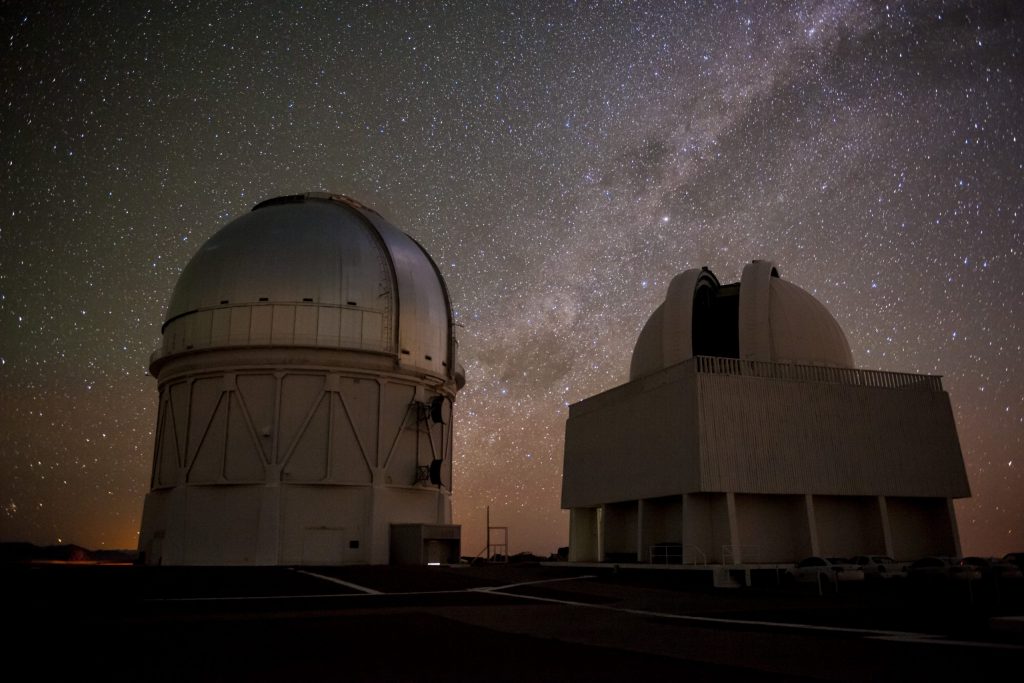
The Dark Energy Survey (DES) recently published results that combine all six years of data collected from weak lensing and galaxy clustering probes – a first for the international collaboration that is mapping hundreds of millions of galaxies, detecting thousands of supernovae and analyzing patterns of cosmic structure that could reveal what is accelerating the expansion of the universe.
The Center for AstroPhysical Surveys (CAPS) led end-to-end data processing and archival for DES using the DES Data Management System at the National Center for Supercomputing Applications. NCSA operated the data management and computing infrastructure that processed, quality-controlled and served the full DES imaging and catalog data set, enabling the creation of science-ready sky maps and cosmological measurements.
“Dark energy and the universe’s accelerating expansion sit at the boundary between what we can measure precisely and what we can explain,” said CAPS Director Joaquin Vieira. “Pinning down what is driving that acceleration would reshape our understanding of the universe’s fate and force revisions to the deepest laws that describe space, time and matter.
“The latest results from the Dark Energy Survey were enabled by CAPS leadership and NCSA’s data management and computing backbone.”
This new analysis from DES narrows the controls in modeling the behavior of the universe thanks to combining the data from four different probes: baryon acoustic oscillations, type-Ia supernovae, galaxy clusters and weak gravitational lensing. Scientists hope to use this research to explore various other models for phenomena in the universe, including dark energy and alternative gravity.
“The latest DES release emphasizes that the new constraints are tighter than prior DES analyses while remaining broadly consistent with earlier DES results,” Vieira said. “It frames the methodology as a template for next-generation surveys such as the U.S. National Science Foundation and Department of Energy’s Vera C. Rubin Observatory Legacy Survey of Space and Time.”
CAPS connects data infrastructure expertise at NCSA to astrophysics teams at the University of Illinois Urbana-Champaign and supports the people and workflows that turn survey-scale data into science results. NCSA is a founding partner of the DES project, along with Fermilab and NOIRLab.
Find out more about the DES news in the announcement from Fermilab.