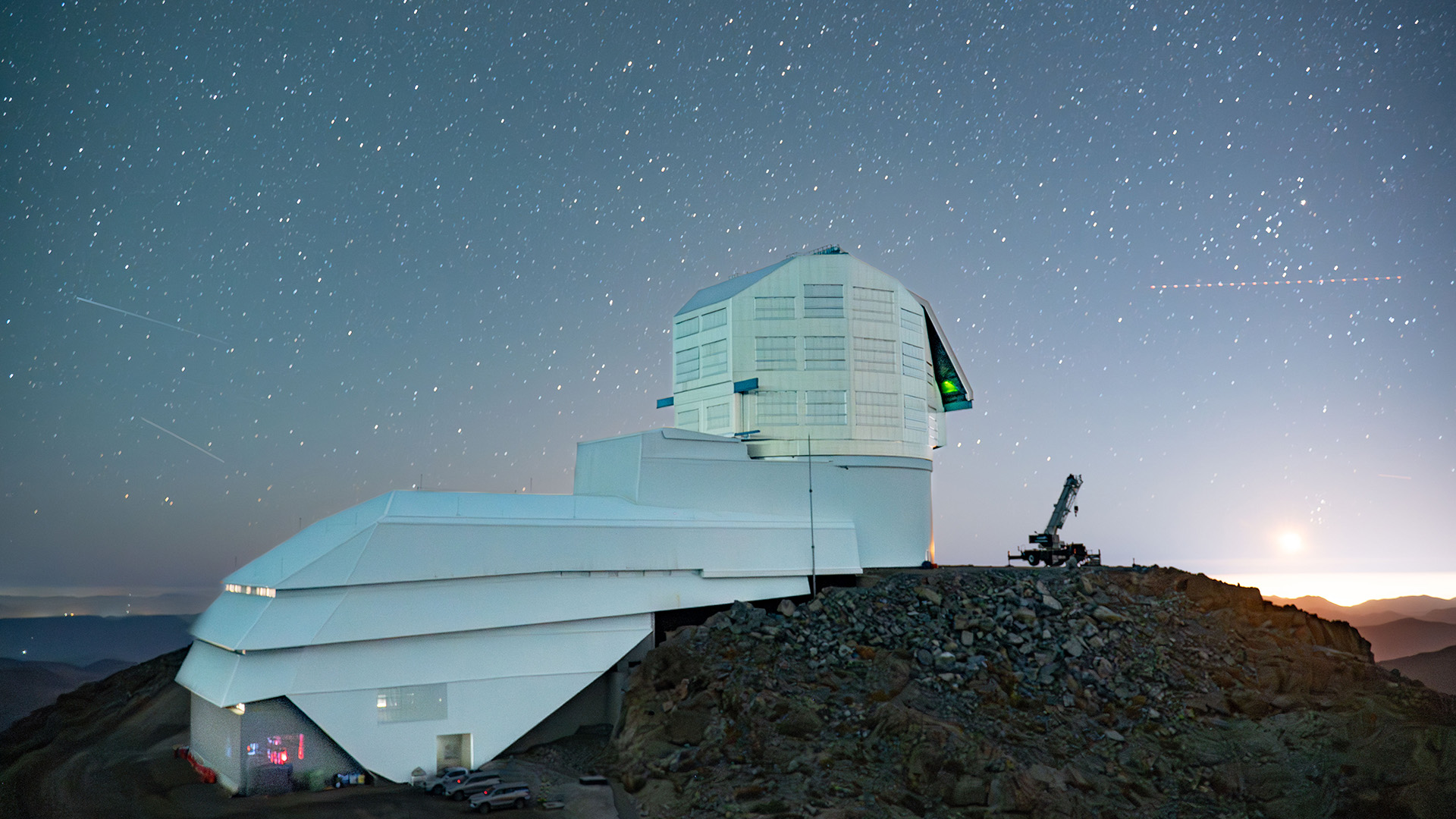
For astronomers, researchers and space lovers across the globe, the long wait is finally over.
Following approval from the U.S. National Science Foundation review board, the Legacy Survey of Space and Time (LSST) began its mission to create a decade-long movie of the southern sky by capturing large volumes of images and data from the Vera C. Rubin Observatory in Chile.
“The start of the LSST survey is the major milestone for Rubin Observatory that we have all been waiting for – some of us for decades,” said Gautham Narayan, spokesperson for the LSST Dark Energy Science Collaboration (DESC) and deputy director for astrophysics research at the NSF-Simons SkAI Institute. “Construction is substantially complete, and the telescope is delivering image quality close to its design specification, enough to carry out an extraordinary science program. For my team, that means mapping the time-domain sky and cataloging the different ways stars die, pairing Rubin with data from the Roman Space Telescope and the Euclid Space Telescope to probe the nature of dark energy and dark matter, and building AI models to analyze it all at scale. But Rubin will transform almost every area of astrophysics, so we’re really entering a golden era for survey science.”
Of course, testing has been ongoing, with the state-of-the-art Simonyi Survey Telescope’s “first light” images released publicly in June 2025, and the transition from observatory construction to operations took place a few months later. The Center for AstroPhysical Surveys (CAPS) at the National Center for Supercomputing Applications (NCSA) is helping to process the enormous amount of data already collected and has assisted in creating the First Alert system, which enables scientists around the world to coordinate follow-up observations of space phenomena.
“I’m very excited to see the start of the survey,” said Stephen Pietrowicz, a principal research software engineer at NCSA. “Many people at NCSA have worked for years on this project, and it’s exciting to be able to share what we’ve been working on with the world.”
Pietrowicz has worked on LSST almost since its inception more than 20 years ago and has seen the extensive collaboration required to steer such a massive, never-before-seen project to this watershed moment in astronomy.
“The astronomy community will have more data than ever to work with, which will lead to new discoveries,” Pietrowicz said. “The general public will be able to see bigger images than have ever been available before, and this work will be inspirational to students who might be considering what they’d like to study.”
Researchers from NCSA and the University of Illinois Urbana-Champaign have been instrumental in the work done to date at the observatory and will continue their efforts as the project shifts to a more traditional research focus.
“For many of us, this is the moment when years of preparation turn into real discovery. LSST will not just give us beautiful images of the sky; it will provide an unprecedented stream of data that lets us study how the universe changes over time,” said Ayan Mitra, a CAPS postdoctoral fellow and pipeline scientist for LSST. “For my own work on supernovae and cosmology, this means we can begin building the tools to connect Rubin’s alerts and images to measurements of dark energy and the history of the universe.”
LSST is designed to address some of astronomy’s biggest questions, including mapping the distribution of dark matter and probing the nature of dark energy in the universe, discovering and tracking near-Earth asteroids and other objects within the solar system, and detecting supernovae and other transient events in near real time.
“LSST’s Type Ia supernovae will tighten the dark energy constraints by a factor of two to two-and-a-half over what the Dark Energy Survey achieved simply from the sheer number of supernovae we’ll see,” said Srinivasan Raghunathan, a former CAPS postdoctoral fellow and now assistant project scientist at the University of California, Davis. “Combining them with the Cosmic Microwave Background and the Dark Energy Spectroscopic Instrument (DESI) Baryon Acoustic Oscillations measurements tightens things dramatically further, since each probe constrains a different epoch of the universe’s expansion.”
Graduate and doctoral students are getting in on the action as well, showing that LSST will surely launch many a career for young astronomers, and Rubin is also providing new international opportunities.
Working with the Danish LSST International Data Access Center, a team of DESC members led by Narayan and colleagues at Princeton University, Penn State University and DARK, an astrophysics research section at the Niels Bohr Institute at the University of Copenhagen, have been working on combining Rubin data with Euclid Space Telescope data. This is a pairing very few groups anywhere can make, since LSST is largely a U.S.-led project and Euclid is an almost exclusively European one.
Together, the team has been using NCSA’s and DARK’s supercomputers to develop a pipeline that does “joint-pixel processing” on both surveys, increasing the resolution of LSST galaxies using the space-based Euclid data, extending the physical information into the near-infrared and helping detect exotic sources such as strongly gravitationally lensed transients.
“It has been exciting for me and my students and postdocs to work with the team in Illinois and in DESC. For 14 years, we’ve been knocking on this door, and now it has opened,” said Christa Gall, director of the Danish IDAC and an associate professor at the Niels Bohr Institute, who visited the University of Illinois last year.
“This is probably one of the most exciting times to be a graduate student,” said Padmavathi Venkatraman, a graduate student in the Department of Astronomy at Illinois. “I currently work on making and using Rubin-simulated data of strong gravitational lenses to validate our analysis pipelines, building towards the LSST time-delay cosmography probe. Watching Rubin go live and the alerts stream in has been incredible, and I’m excited for the early science results that will be coming out.”
“LSST has connected me with collaborators from across the world to prepare for the incoming flood of data,” said Amanda Wasserman, a doctoral student in the Department of Astronomy at Illinois. “I have spent my entire PhD testing our algorithms on simulated observations, and as I finish, those same algorithms are running on real data, discovering rare transients and probing the nature of dark energy.”
“Huge congratulations are due to the Rubin team and the people at NCSA and CAPS who have worked tirelessly to get us to the start of LSST,” Narayan said. “Now the fun really begins!”
For more information on the official start of LSST, check out the press release from the Vera C. Rubin Observatory.
ABOUT CAPS
NCSA’s Center for AstroPhysical Surveys (CAPS) brings cohesion and advancement to astrophysical survey science efforts across the University of Illinois Urbana-Champaign. CAPS offers annual postdoctoral and graduate fellowship programs, publishes vast amounts of astronomical data from a broad portfolio of astrophysical surveys and collaborates across disciplines to enable trailblazing research.