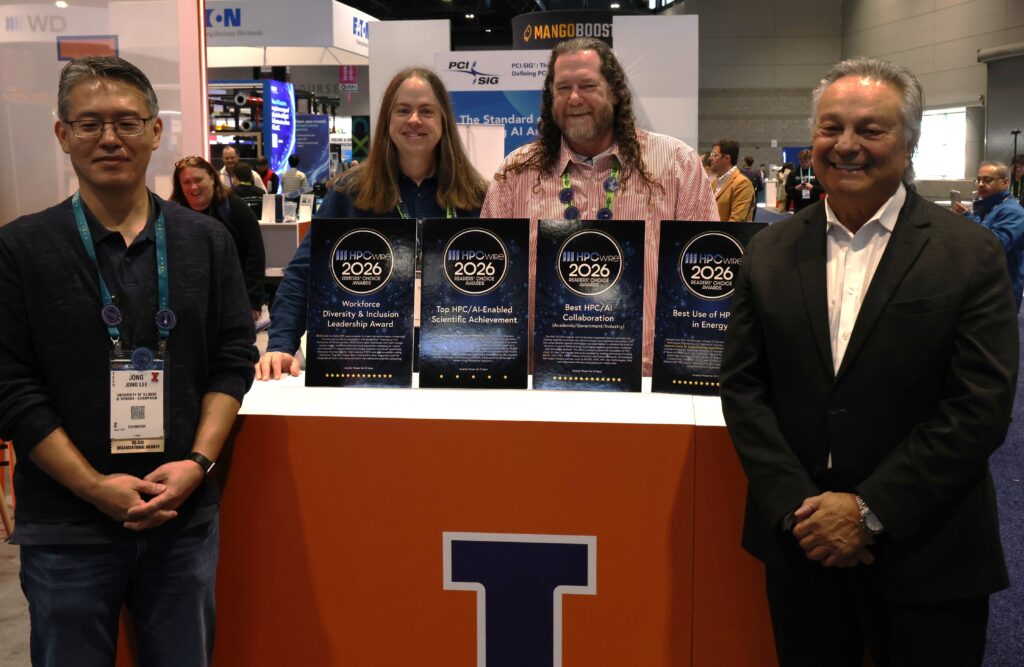
The National Center for Supercomputing Applications (NCSA) was recognized for outstanding achievements in four domains in the annual HPCwire Readers’ and Editors’ Choice Awards, announced at Supercomputing Conference 2026 (SC26) in Chicago on November 19. It’s the 16th consecutive year NCSA has been honored with an HPCwire award.
Two awards highlight NCSA’s ability to support groundbreaking, impactful research in cellular biology and energy. Two more awards highlight NCSA’s leadership in national cyberinfrastructure and accessibility efforts.
“These awards showcase NCSA’s ability to facilitate impactful public research in a wide variety of fields,” said NCSA Director R. Srikant. “NCSA continues to be a leader in providing high-performance computing resources to researchers across the country, supporting their innovative work with our technical and domain expertise.”
A list of all of the winners can be found on the HPCwire website. NCSA was recognized for:
Readers’ Choice: Top HPC/AI-Enabled Scientific Achievement. The University of Illinois Urbana-Champaign, Johns Hopkins University, Harvard Medical School/Boston Children’s Hospital, and the J. Craig Venter Institute developed the world’s first complete 4D whole-cell model of an entire 100-minute cell cycle, simulating the minimal bacterium JCVI-syn3A as it grows and divides. Generating 50 unique cell trajectories required over 15,000 GPU hours (250 GPU hours per biological run) on supercomputers like NCSA’s Delta HPE system. Beyond matching experimental measurements, this physical simulation provides researchers a predictive “computational microscope” to probe living intracellular mechanics.
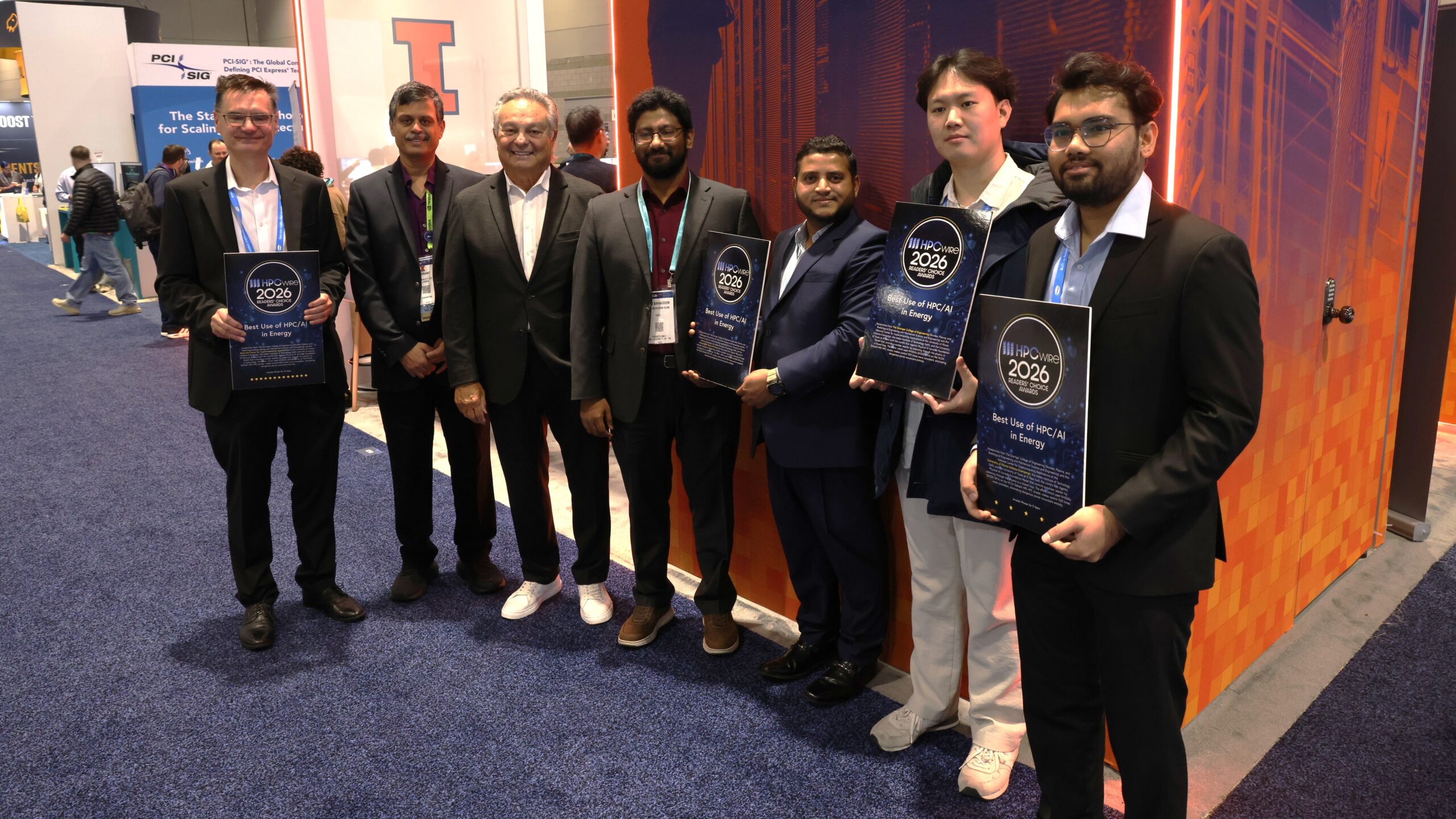
Readers’ Choice: Best Use of HPC/AI in Energy. Researchers from The Grainger College of Engineering (Nuclear, Plasma, and Radiological Engineering and Mechanical Science and Engineering) and the National Center for Supercomputing Applications at the University of Illinois Urbana-Champaign, the Indian Institute of Technology Delhi and the University of Texas at El Paso built the world’s first Agentic Physical AI towards Foundation Model that controls a nuclear reactor by reasoning through the physics in a closed loop. The effort, which used Nvidia’s GH200 GPUs on the NCSA DeltaAI HPE HPC cluster, makes control 500 times more consistent, eliminating dangerous power excursions entirely.
Readers’ Choice: Best HPC/AI Collaboration (Academia/Government/Industry). The NSF ACCESS program and its 14 integrated resource providers are working together to provide the nation’s research and education community with the computational capacity and support services needed to advance the state of the art in AI and all fields of study by bringing together government, academia and technology partners. The effort involves a nationwide ecosystem of HPC, cloud, AI, data, and storage resources operated by leading institutions including NCSA, TACC, PSC, SDSC, Indiana University and Purdue University. Technologies from major industry partners such as NVIDIA, AMD, HPE, Dell, Intel and associated software ecosystems are widely used.
Editors’ Choice: Workforce Diversity & Inclusion Leadership Award. NCSA built its Delta HPE supercomputer to make high-performance computing far more accessible to researchers with disabilities. Teaming up with University of Illinois partners, NCSA hosts open workshops that walk through screen-reader workflows and non-visual interaction strategies for cluster environments. To support blind and visually impaired individuals specifically, the group develops tactile, multi-sensory STEM tools and accessible coding interfaces. Together, these efforts help build a clear, supportive path for marginalized talent from early education into advanced scientific computing.
The coveted annual HPCwire Readers’ Choice Awards are determined through a nomination and voting process with the global HPCwire community, as well as selections from the HPCwire editors. The awards are an annual feature of the publication and constitute prestigious recognition from the HPC community. They are revealed each year to kick off the annual supercomputing conference, which showcases high-performance computing, networking, storage and data analysis.
“As HPCwire celebrates 38 years of covering high-performance computing, the combined power of HPC and AI is accelerating discovery and reshaping what science and industry can achieve. Our 2027 Readers’ and Editors’ Choice Awards celebrate the people, organizations and innovations driving that progress,” said Tom Tabor, CEO of TCI Media, publishers of HPCwire. “Throughout the world, our community is tackling grand challenges whose solutions will improve lives for generations to come. Yet too often, these accomplishments remain out of the spotlight, and the people behind them receive even less recognition for their contributions to society. These awards help bring their achievements to light. Drawing on the expertise of our worldwide readership and the perspective of our editorial team, they recognize the depth, ingenuity and impact of HPC innovation across the globe. To all of this year’s winners, our sincere gratitude and heartfelt congratulations.”
HPCwire is a news site and weekly newsletter covering the fastest computers in the world and the people who run them. As the trusted source for HPC news since 1987, HPCwire serves as the publication of record on the issues, opportunities, challenges and community developments relevant to the global high-performance computing space. Its reporting covers the vendors, technologies, users and the uses of high-performance, AI and data-intensive computing within academia, government, science and industry.
ABOUT NCSA
The National Center for Supercomputing Applications at the University of Illinois Urbana-Champaign provides supercomputing, expertise and advanced digital resources for the nation’s science enterprise. At NCSA, University of Illinois faculty, staff, students and collaborators from around the globe use innovative resources to address research challenges for the benefit of science and society. NCSA has been assisting many of the world’s industry giants for over 35 years by bringing industry, researchers and students together to solve grand challenges at rapid speed and scale.